Post by : Sam Jeet Rahman
Virtual Reality (VR) is transforming the way we teach and learn, offering immersive experiences that make education more engaging and interactive. From virtual classrooms to 3D simulations, VR allows students to explore concepts in ways traditional methods cannot. However, like any technology, it comes with both opportunities and challenges. Understanding these can help educators, students, and institutions make the most of VR in education.
VR technology creates simulated environments that users can interact with, making learning hands-on and experiential. Some reasons for its growing adoption include:
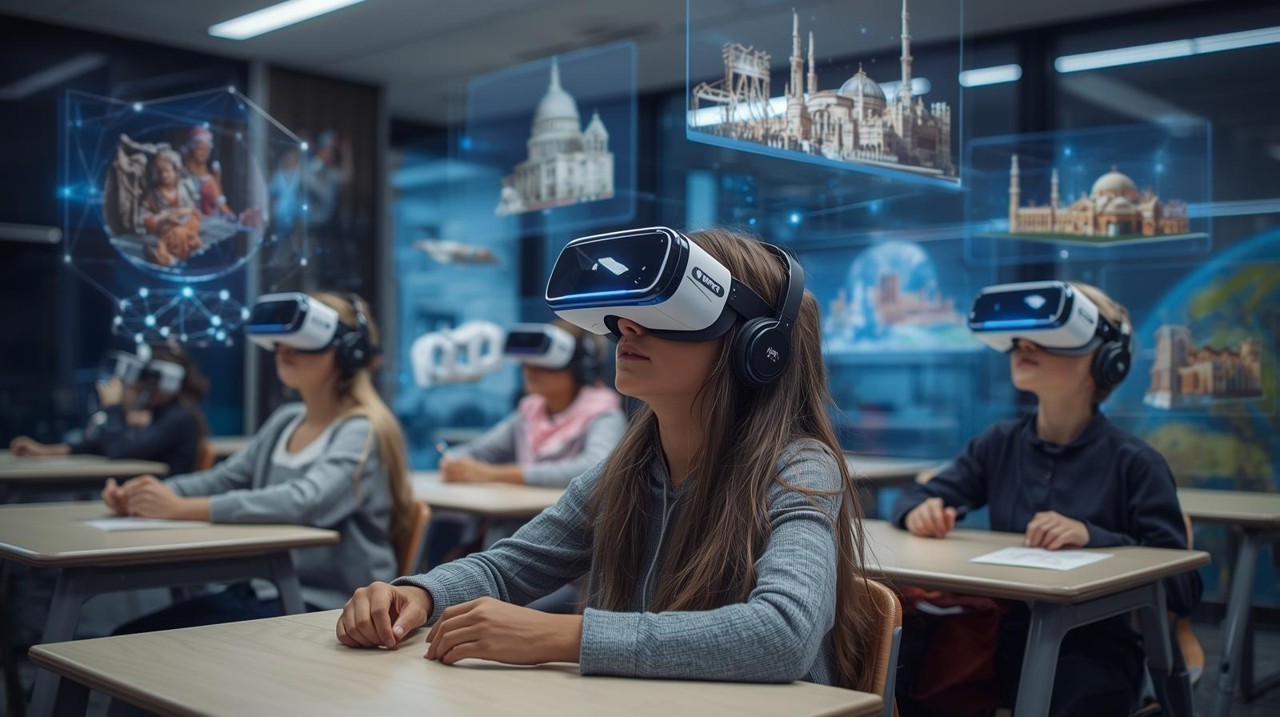
Immersive Learning: Students can explore historical events, scientific phenomena, or distant locations as if they were physically there.
Enhanced Engagement: VR captures attention more effectively than traditional lectures or textbooks.
Practical Training: VR is useful for medical simulations, engineering labs, and vocational training without real-world risks.
Accessibility: Remote students can access interactive learning experiences from anywhere.
These advantages make VR a powerful tool to enhance understanding and retention.
VR allows students to learn by doing, whether it’s dissecting a virtual frog, conducting chemical experiments, or exploring space. Hands-on experiences deepen comprehension and memory retention.
VR can cater to different learning styles. Visual, auditory, and kinesthetic learners all benefit from immersive simulations. It can also help students with special needs by providing customized learning environments.
Students can virtually travel to historical sites, museums, or foreign countries without leaving the classroom, broadening their perspective and cultural awareness.
For fields like medicine, aviation, and engineering, VR allows practice without real-world risks. Mistakes in VR become learning opportunities rather than dangerous errors.
Despite its potential, VR comes with certain limitations that educators must consider:
VR hardware and software can be expensive, making it difficult for schools with limited budgets to implement.
Maintaining equipment and updating software adds ongoing costs.
VR requires high-speed internet, compatible devices, and technical support.
Technical glitches can interrupt lessons, reducing the effectiveness of VR-based learning.
Prolonged VR use may cause eye strain, dizziness, or motion sickness.
Proper guidelines and breaks are essential to ensure student safety and comfort.
While VR content is growing, there is still a lack of high-quality, curriculum-aligned resources for many subjects.
Educators may need to invest time or money in custom VR content, which can be challenging.
Teachers need specialized training to effectively integrate VR into lessons.
Without proper guidance, VR may become a novelty rather than a learning tool.
The potential of VR in education is immense:
Hybrid Learning Models: Combining VR with traditional teaching can create more engaging and effective curricula.
Personalized Learning: VR can track student interactions and adapt content to individual learning needs.
Global Collaboration: Students from different countries can meet in shared virtual classrooms, enhancing cross-cultural learning.
Gamified Education: VR can integrate games and simulations to make learning fun and interactive.
As technology improves and costs decrease, VR is likely to become a standard part of modern classrooms worldwide.
Virtual Reality is revolutionizing education by providing immersive, interactive, and practical learning experiences. While it offers unmatched opportunities for engagement and skill development, challenges like cost, technical requirements, and health considerations must be addressed.
For schools, educators, and policymakers, the key is to balance innovation with accessibility, ensuring that VR enhances learning without leaving students or teachers behind. With careful planning and thoughtful implementation, VR has the potential to reshape education for the better in the years to come.

US Stocks Slide as AI Fears, Inflation and Oil Surge Weigh
US stocks dropped as AI disruption fears hit tech firms, inflation rose above forecasts, and oil pri

Pacific Prime Wins Top Honors at Cigna Awards 2026
Pacific Prime secured Top Individual Broker and Top SME Broker awards at Cigna’s Annual Broker Award

QatarEnergy Halts LNG Output After Military Attack
QatarEnergy has stopped LNG production after military attacks hit its facilities in Ras Laffan and M

Strong 6.1 Magnitude Earthquake Hits West Sumatra, No Damage
A 6.1 earthquake struck off West Sumatra, Indonesia. No casualties, damage, or tsunami alert reporte

Saudi Confirms Drone Strike on US Embassy Riyadh
Two drones hit the US Embassy in Riyadh, causing a small fire and minor damage. No injuries were rep

UAE Restarts Limited Flights as Regional Airspace Disruptions Continue
UAE restarts limited flights from Dubai as US-Israel attacks on Iran disrupt regional airspace, forc

Asia Faces Energy Shock After Iran Closes Strait
Iran shuts Strait of Hormuz amid US-Israel strikes, sending oil prices higher and raising serious en


Bank of Baroda Faces Abu Dhabi Legal Battle over NMC Collapse
Bank of Baroda’s involvement in Abu Dhabi litigation tied to the NMC Healthcare collapse raises repu

Top Museum Openings of 2026 Set to Transform Global Tourism
From Los Angeles to Abu Dhabi and Brussels, 2026 brings major museum launches—Lucas Museum, Guggenhe

UAE Tour Highlights UAE’s Strength in Hosting Global Sports Events
Abu Dhabi Sports Council says the successful UAE Tour reflects the UAE’s leading role in hosting maj

EU Seeks Clarity from US After Supreme Court IEEPA Ruling
European Commission urges full transparency from the US on steps after Supreme Court ruling, emphasi

SpaceX Launches 53 New Satellites for Expanding Starlink Network
SpaceX launches 53 Starlink satellites in two Falcon 9 missions, breaking reuse records and expandin

RTA Awards Contract for Phase II of Hessa Street Upgrade in Dubai
Phase II of Hessa Street Development to add bridges, tunnel, and upgraded intersections, doubling ca

UAE Gold Prices Today, Monday 16 February 2026: Dubai & Abu Dhabi Updated Rates
Gold prices in UAE on 16 Feb 2026 updated: 24K around AED 599.75/gm, 22K AED 555.25/gm, and 18K AED

Over 25 Ahmedabad Schools Receive Bomb Threat Email, Authorities Investigate
More than 25 schools in Ahmedabad evacuated after bomb threat emails mentioning Khalistan. Authoriti





