Post by : Anis Karim
In early 2026, the Shaksgam Valley dispute has reignited as China has publicly restated its claims to the territory, leading to vocal opposition from India. This unfolding scenario has garnered global attention given its ties to ongoing border disputes, affecting regional stability and strategic infrastructure endeavors. China's recent insistence on legitimizing projects in the area rekindles diplomatic tensions, spotlighting the intricate triangle of relations between India, China, and Pakistan.
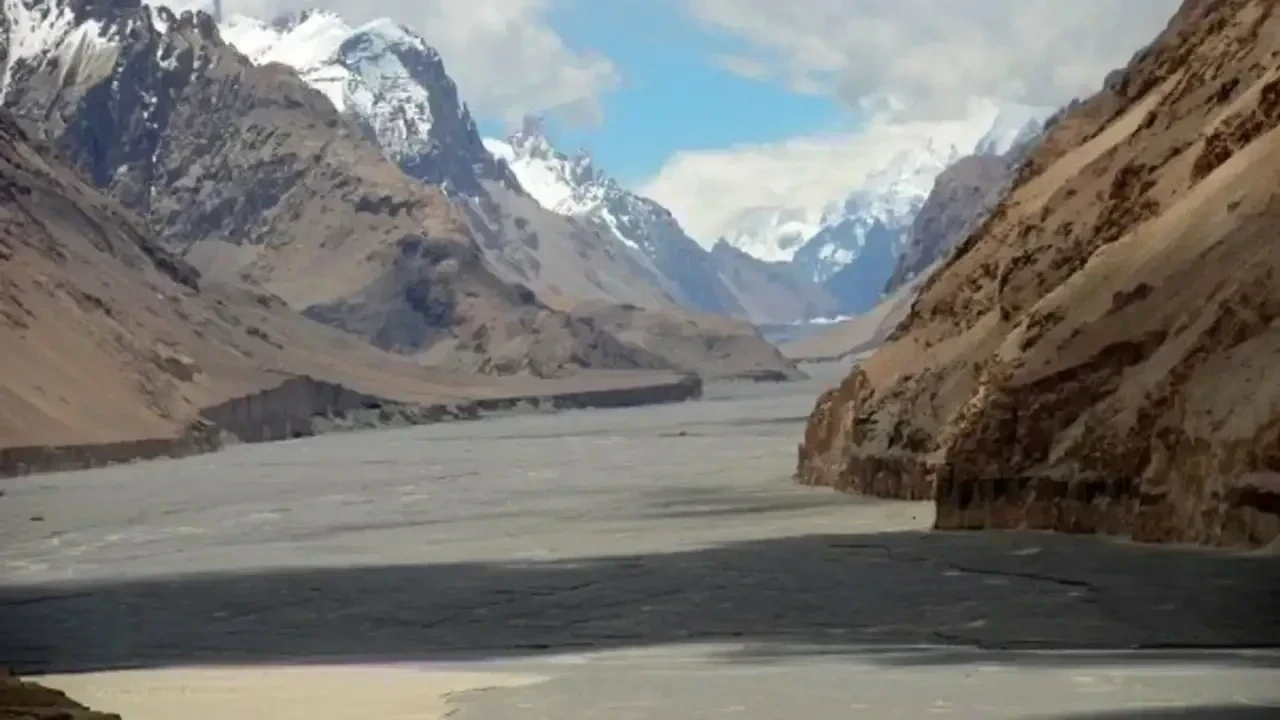
The Shaksgam Valley, known as the Trans-Karakoram Tract, is positioned north of the Siachen Glacier within the Karakoram range. While administered by China, India maintains that this valley is integral to its territory, citing historical and legal grounds related to sovereignty and treaties. This article examines the origins of the conflict, its strategic significance, the stances of each involved nation, and the wider geopolitical outcomes.
Shaksgam Valley is at the northern frontier of what India claims as its territory in Jammu and Kashmir, nestled between the imposing Karakoram and Kunlun mountain ranges along the Shaksgam River's source. Despite its harsh and isolated landscape, which limits extensive human settlement, this remote area has captured strategic interest.
Close to the Siachen Glacier, a highly contested military zone, and key transit routes related to the China-Pakistan Economic Corridor (CPEC), the valley commands significant geopolitical relevance. Control here influences military and economic dominion in a region defined by its challenging geography.
Prior to the 1947 partition of British India, Shaksgam Valley belonged to the princely state of Jammu and Kashmir. Following the partition and subsequent conflicts involving India and Pakistan, varying sectors of the region, including parts now identified as Pakistan-occupied Kashmir, fell under Pakistani administration. This set the foundation for a complex web of territorial discussions among India, Pakistan, and China.
The crux of the ongoing dispute stems from the 1963 boundary agreement between China and Pakistan, wherein Pakistan consented to transfer authority of the Shaksgam Valley to China, contingent on the Kashmir dispute's resolution. India, asserting its historical claims, disputes the legality of this agreement, arguing that Pakistan cannot legitimately cede territory India claims as its own.
China has reaffirmed its claim over Shaksgam Valley in early 2026, arguing that the territory legitimately belongs to it and defending ongoing infrastructure projects as necessary and justified. These assertions surfaced amidst Indian protests regarding Chinese activities in the area, including road construction aimed at enhancing connectivity.
India vehemently opposes China's claims, insisting that the Shaksgam Valley is an inalienable part of Indian territory. Government representatives have firmly stated that India never accepted the 1963 boundary accord and views any territorial transfer without its agreement as invalid. The Ministry of External Affairs has reiterated that all claims over Jammu and Kashmir, including Shaksgam, are integral to India.
Pakistan finds itself caught in the rivalry between India and China over the Shaksgam Valley. The 1963 agreement—in contravention of Indian claims—demonstrates Pakistan’s earlier attempts to solidify ties with China post-1962 Sino-Indian War. Pakistan’s decision to cede territory stemmed from strategic defense considerations against India, fostering a lasting alliance with China.
The significance of Shaksgam Valley transcends basic territorial disputes. Its closeness to the Siachen Glacier means its strategic relevance cannot be understated, impacting troop movements and supply routes critical to regional defense planning. The growing Chinese infrastructure investment in the area raises concerns over rapid troop repositioning, enhancing the competitiveness of response capabilities.
The ongoing tensions surrounding Shaksgam Valley reflect deeper issues in India-China relations, despite recent efforts aimed at conflict de-escalation. Territorial assertions continue to challenge reconciliation initiatives, underscoring complexities around establishing peace in contested territories.
The dispute surrounding Shaksgam Valley is part of a broader triangle involving India, China, and Pakistan. Each nation encounters unique motivations—India seeks sovereignty, China pursues strategic territorial expansion, and Pakistan aligns itself with China to counterbalance India.
The Shaksgam Valley issue exemplifies how history, geography, and contemporary strategies intersect, sustaining long-standing international conflicts. As China reiterates its claim and India maintains its objections, this dispute remains a focal point for regional security. The valley stands as a symbol of complex interrelations among India, China, and Pakistan, where law, strategy, and historical narratives intertwine with current geopolitical realities.
Disclaimer:
This article draws from publicly available information for informational purposes only and does not represent any official government positions.

US Stocks Slide as AI Fears, Inflation and Oil Surge Weigh
US stocks dropped as AI disruption fears hit tech firms, inflation rose above forecasts, and oil pri

Pacific Prime Wins Top Honors at Cigna Awards 2026
Pacific Prime secured Top Individual Broker and Top SME Broker awards at Cigna’s Annual Broker Award
QatarEnergy Halts LNG Output After Military Attack
QatarEnergy has stopped LNG production after military attacks hit its facilities in Ras Laffan and M

Strong 6.1 Magnitude Earthquake Hits West Sumatra, No Damage
A 6.1 earthquake struck off West Sumatra, Indonesia. No casualties, damage, or tsunami alert reporte

Saudi Confirms Drone Strike on US Embassy Riyadh
Two drones hit the US Embassy in Riyadh, causing a small fire and minor damage. No injuries were rep

UAE Restarts Limited Flights as Regional Airspace Disruptions Continue
UAE restarts limited flights from Dubai as US-Israel attacks on Iran disrupt regional airspace, forc
Asia Faces Energy Shock After Iran Closes Strait
Iran shuts Strait of Hormuz amid US-Israel strikes, sending oil prices higher and raising serious en


Bank of Baroda Faces Abu Dhabi Legal Battle over NMC Collapse
Bank of Baroda’s involvement in Abu Dhabi litigation tied to the NMC Healthcare collapse raises repu

Top Museum Openings of 2026 Set to Transform Global Tourism
From Los Angeles to Abu Dhabi and Brussels, 2026 brings major museum launches—Lucas Museum, Guggenhe

UAE Tour Highlights UAE’s Strength in Hosting Global Sports Events
Abu Dhabi Sports Council says the successful UAE Tour reflects the UAE’s leading role in hosting maj

EU Seeks Clarity from US After Supreme Court IEEPA Ruling
European Commission urges full transparency from the US on steps after Supreme Court ruling, emphasi

SpaceX Launches 53 New Satellites for Expanding Starlink Network
SpaceX launches 53 Starlink satellites in two Falcon 9 missions, breaking reuse records and expandin

RTA Awards Contract for Phase II of Hessa Street Upgrade in Dubai
Phase II of Hessa Street Development to add bridges, tunnel, and upgraded intersections, doubling ca

UAE Gold Prices Today, Monday 16 February 2026: Dubai & Abu Dhabi Updated Rates
Gold prices in UAE on 16 Feb 2026 updated: 24K around AED 599.75/gm, 22K AED 555.25/gm, and 18K AED

Over 25 Ahmedabad Schools Receive Bomb Threat Email, Authorities Investigate
More than 25 schools in Ahmedabad evacuated after bomb threat emails mentioning Khalistan. Authoriti