Post by : Anis Karim
After nearly two decades of negotiations, India and the European Union (EU) have achieved a pivotal milestone with the signing of a comprehensive Free Trade Agreement (FTA) during the 16th India-EU Summit on 27 January 2026. This momentous arrangement, referred to by officials as the “mother of all trade deals,” marks a significant leap in bilateral relations, promising extensive benefits for trade, investment, strategic partnerships, and geopolitical alignment.
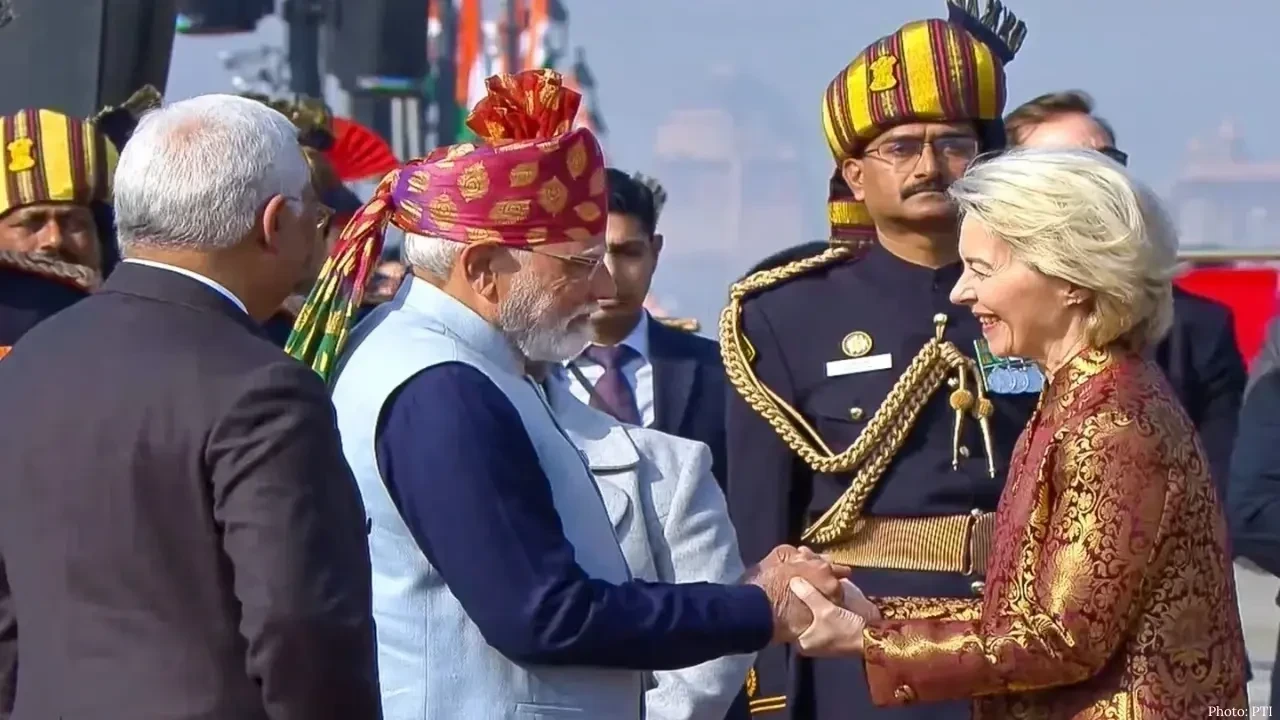
Co-chaired by Prime Minister Narendra Modi, European Commission President Ursula von der Leyen, and European Council President Antonio Costa, the summit took place in New Delhi, coinciding with India’s 77th Republic Day celebrations, which were attended by high-level leaders.
This article delves into the outcomes of the summit, detailing the key aspects of the deal, market reactions, and its broader implications on the global stage.
India’s interactions with the EU span decades of diplomatic and economic collaboration. Efforts towards a free trade agreement began in 2007, although significant progress was stalled until the early 2020s.
By 2024–25, the total trade between India and the EU had surged to approximately $136.5 billion, designating the EU as India’s largest trading partner in merchandise. India’s exports—which include textiles, chemicals, and machinery—have increased significantly, while EU exports encompass various industrial products.
The collaboration has also extended into climate initiatives, technology, and defense, culminating in a new Strategic EU-India Agenda aimed at fostering deeper connections.
After almost 20 years of discussions, the India-EU FTA negotiations have reached completion, with officials confirming a formal announcement during the India-EU Summit on January 27, 2026.
Characterized as a balanced and progressive agreement, it is expected to encompass trade in goods, services, investments, and tariff reductions across various sectors.
A key feature of the FTA is the significant reduction of import duties. India plans to considerably lower tariffs on many EU imports, while the EU is likely to provide duty-free access to Indian products, notably in sectors like textiles, leather, and machinery.
Current EU tariffs on imports from India stand at around 3.8%, with higher rates for labor-intensive goods, while India’s average tariff on EU imports reaches approximately 9.3%. The FTA aims to reduce these barriers, promoting bilateral export growth.
The trade pact is anticipated to significantly boost economic engagement on both sides. Initial projections from analysts suggest Indian exports to the EU could increase by $3–5 billion shortly, building upon a near $76 billion export volume in 2024–25.
This growth potential is especially promising for labour-intensive sectors, where lower tariffs are forecasted to enhance market access and diminish reliance on traditional markets amid global uncertainties.
Investor sentiment rose sharply post-summit, with stocks in sectors like textiles and seafood benefiting from the anticipated market expansion.
The summit not only focused on trade but also highlighted progress in security, technology, and climate cooperation, positioning India and the EU as collaborative partners on a global scale.
Officials are set to enhance strategic collaboration, creating a Security and Defence Partnership to explore further integration in defense and mutual training initiatives.
The summit was an opportunity for extensive discussions on vital topics such as climate action, regional stability, and multilateral cooperation.
The timing of the India-EU FTA is crucial as it responds to a landscape characterized by rising barriers in various economies. Leaders highlighted that this deal sends a robust political signal supporting open markets and diversification.
European Council President Antonio Costa remarked that the agreement not only solidifies economic ties but echoes a shared commitment towards global cooperation amid protectionist tendencies.
This key FTA encapsulates India’s strategy to extend its trade networks beyond traditional partners. As New Delhi seeks to establish connections with regions such as the UK and New Zealand, this agreement enhances its involvement in global trade.
Despite the agreement’s announcement, several procedural steps must be navigated to implement the FTA:
In India, the pact will need clearance from the Union Cabinet and legislative bodies.
In the EU, ratification by the European Parliament according to organizational procedures is required.
Formal signing is anticipated later in 2026, with gradual implementation expected to begin in 2027 once legislative conditions are satisfied.
Markets responded quickly to the FTA news, particularly among sectors poised to benefit from tariff reductions. Companies in textiles, shrimp, and other key industries experienced notable stock price increases in anticipation of enhanced market opportunities.
Industry representatives expressed their support for the agreement, highlighting opportunities for greater integration into international supply chains and improved competitiveness. Analysts noted that the deal’s balanced structure aims for sustainable growth without overwhelming domestic markets.
The India-EU Free Trade Agreement redefines one of the world's most significant economic relationships. By dismantling trade barriers and encouraging investment flows, this pact sets a pathway for sustained economic cooperation with global repercussions.
The success of this agreement will depend not only on effective implementation but also on continued diplomatic support and adaptability to an evolving economic landscape.
Together, India and the EU—representing nearly 20% of global trade and around a quarter of the global population—have established a framework for collective prosperity that could influence economic dynamics for years to come.
Disclaimer:
This article is intended for informational purposes only and should not be regarded as financial or legal advice. The information presented reflects the developments and expert analysis available at the time of writing and is subject to change as formal processes unfold.

US Stocks Slide as AI Fears, Inflation and Oil Surge Weigh
US stocks dropped as AI disruption fears hit tech firms, inflation rose above forecasts, and oil pri

Pacific Prime Wins Top Honors at Cigna Awards 2026
Pacific Prime secured Top Individual Broker and Top SME Broker awards at Cigna’s Annual Broker Award

QatarEnergy Halts LNG Output After Military Attack
QatarEnergy has stopped LNG production after military attacks hit its facilities in Ras Laffan and M

Strong 6.1 Magnitude Earthquake Hits West Sumatra, No Damage
A 6.1 earthquake struck off West Sumatra, Indonesia. No casualties, damage, or tsunami alert reporte

Saudi Confirms Drone Strike on US Embassy Riyadh
Two drones hit the US Embassy in Riyadh, causing a small fire and minor damage. No injuries were rep

UAE Restarts Limited Flights as Regional Airspace Disruptions Continue
UAE restarts limited flights from Dubai as US-Israel attacks on Iran disrupt regional airspace, forc

Asia Faces Energy Shock After Iran Closes Strait
Iran shuts Strait of Hormuz amid US-Israel strikes, sending oil prices higher and raising serious en


Bank of Baroda Faces Abu Dhabi Legal Battle over NMC Collapse
Bank of Baroda’s involvement in Abu Dhabi litigation tied to the NMC Healthcare collapse raises repu

Top Museum Openings of 2026 Set to Transform Global Tourism
From Los Angeles to Abu Dhabi and Brussels, 2026 brings major museum launches—Lucas Museum, Guggenhe

UAE Tour Highlights UAE’s Strength in Hosting Global Sports Events
Abu Dhabi Sports Council says the successful UAE Tour reflects the UAE’s leading role in hosting maj

EU Seeks Clarity from US After Supreme Court IEEPA Ruling
European Commission urges full transparency from the US on steps after Supreme Court ruling, emphasi

SpaceX Launches 53 New Satellites for Expanding Starlink Network
SpaceX launches 53 Starlink satellites in two Falcon 9 missions, breaking reuse records and expandin

RTA Awards Contract for Phase II of Hessa Street Upgrade in Dubai
Phase II of Hessa Street Development to add bridges, tunnel, and upgraded intersections, doubling ca

UAE Gold Prices Today, Monday 16 February 2026: Dubai & Abu Dhabi Updated Rates
Gold prices in UAE on 16 Feb 2026 updated: 24K around AED 599.75/gm, 22K AED 555.25/gm, and 18K AED

Over 25 Ahmedabad Schools Receive Bomb Threat Email, Authorities Investigate
More than 25 schools in Ahmedabad evacuated after bomb threat emails mentioning Khalistan. Authoriti





