Post by : Anis Karim
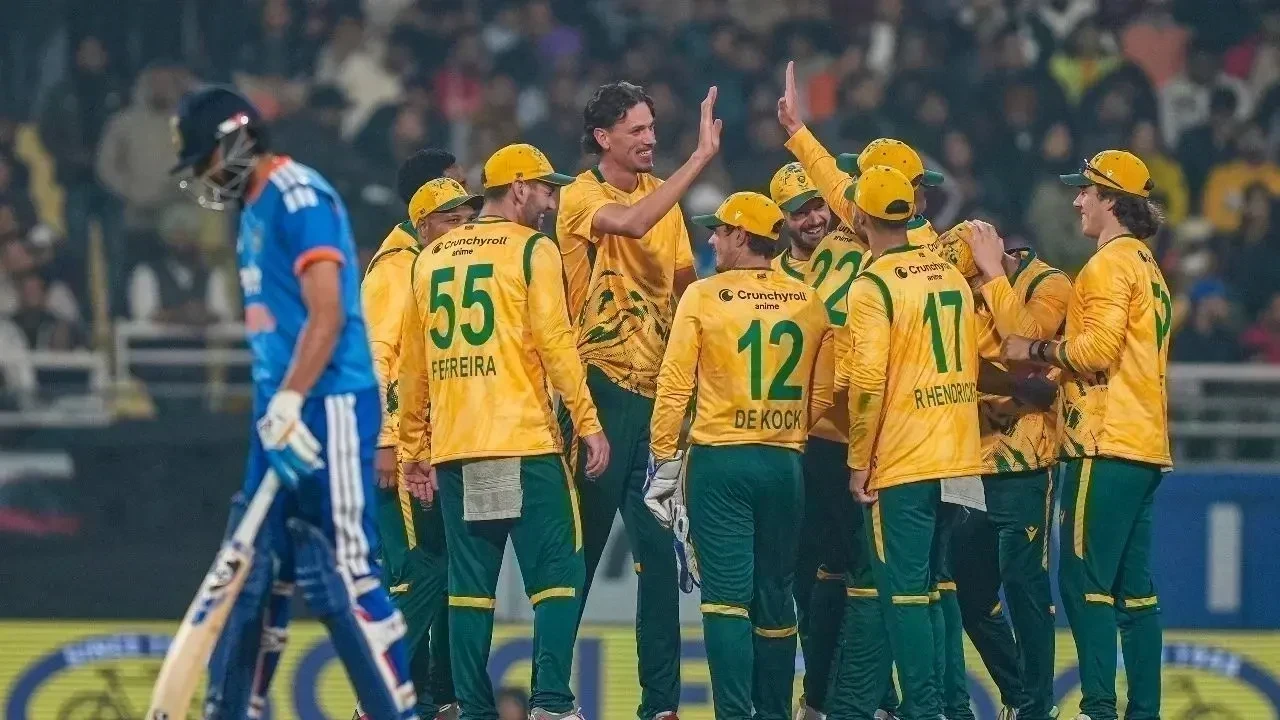
The second T20 International between India and South Africa promised excitement as both teams fought for a crucial series lead. However, it was South Africa that seized complete control, outshining India in nearly every aspect of the game. The Proteas showcased their all-round prowess, while India struggled to make key plays, concluding with a solid 51-run triumph for South Africa, leveling the series and shifting momentum significantly. This match not only highlighted India's struggles but also underscored South Africa's tactical execution.
Throughout the innings, South Africa demonstrated a modern T20 template marked by aggressive starts, careful consolidation, and a powerful finish. India, on the other hand, looked out of sync from the very start of their chase, unable to exert the pressure necessary to challenge South Africa's substantial target. This match raises questions about India's strategy and adaptability as they face a pivotal turning point in the series.
Quinton de Kock was the standout performer for South Africa, delivering a knock that elevated the team’s spirits and set a competitive tone from the beginning. His ability to manipulate the field effectively and make decisive choices against both pace and spin proved crucial, as he maintained a steady flow of runs by punishing loose deliveries. His strategy was essential on a pitch with variable pace, requiring batters to adjust their timing and shot selection.
Remarkably, South Africa sustained momentum throughout the middle overs, avoiding slowdowns that often accompany the end of powerplay restrictions. Their methodical approach ensured that even as India attempted to regain control with spin, the scoreboard pressure kept mounting. By forming solid partnerships and preserving wickets, they set the stage for a robust finish.
The late innings saw power hitters like David Miller and Donovan Ferreira accelerate smartly, demonstrating disciplined fundamentals. By strategically targeting bowlers during specific overs, South Africa capitalized on the Indian bowling unit's lack of rhythm, successfully surpassing the 200-run mark and setting a daunting target.
India's bowling began with promise but quickly deteriorated under pressure. Bowlers struggled with line and length, allowing South Africa to capitalize on scoring opportunities. Instead of forcing errors, India provided an array of loose deliveries that hampered their chances of building any pressure.
In the pivotal overs, India failed to secure vital wickets, allowing South Africa to bat with abandon. The spinners lacked effectiveness, while seamers struggled to deceive established batters. This inability to create wicket-taking opportunities proved critical in allowing South Africa to maintain their stronghold.
As late innings approached, India’s difficulties compounded. Breakdown in execution of yorkers and predictable slower balls allowed South Africa to stretch their score, pushing the target beyond the reach of the Indian side. The failure to control the death overs exposed persistent flaws that have plagued India's recent T20 outings.
India's chase faltered dramatically right from the start, losing Shubman Gill to a first-ball dismissal. This early blow disrupted the required momentum, with South Africa’s strategy successfully stifling scoring opportunities, forcing India into a catch-up game almost immediately.
With the dismissals of Abhishek Sharma and Suryakumar Yadav, India found itself in dire straits, unable to adjust to the tactical deliveries capitalized upon by South Africa.
Tilak Varma stood out as a beacon of hope, crafting a resilient half-century based on astute strike rotation and an understanding of the game’s demands. Though his effort highlighted his potential, without support from teammates, it fell short in altering the match’s outcome.
As pressure intensified, India's middle order stumbled, with Jitesh Sharma and others unable to find a rhythm. The mounting required run rate forced them into panic plays. South Africa’s sharp fielding and bowling made the losses more pronounced, accruing pressure as dot balls increased and boundaries remained elusive.
Ultimately, India was all out for 162, well short of the necessary target. This disappointing conclusion stemmed from suffocating pressure and a failure to adapt to South Africa’s bowling variations, marking a stark reminder of their strategic missteps.
South Africa's bowling display was characterized by exceptional discipline. They executed their strategy by focusing on hitting hard lengths and utilizing the pitch's bounce, keeping the Indian side under constant duress.
Though primarily pace-oriented, their spinners contributed significantly during crucial phases, exerting control that forced India into making risks that led to important wickets. This combination was instrumental in South Africa's dominance.
South Africa displayed exceptional skill in the final overs, mixing yorkers and cutters effectively, nullifying India's scoring efforts. Their precise execution contrasted sharply with India’s failures, sealing the match decisively.
His commanding innings set the stage for South Africa’s imposing total.
The loss of three key wickets early on derailed India’s chase.
The impactful finish raised the target out of reach for India.
Without strong partnerships, significant innings failed to materialize under pressure.
South Africa executed clear plans that effectively leveraged India’s weaknesses, particularly in bowling discipline.
Immediate enhancements are necessary for India in bowling consistency and top-order reliability as crucial gaps surfaced that could influence future selections.
With this win, South Africa gained significant psychological leverage, raising pressure on India ahead of the remaining fixtures.
The second T20I showcased South Africa's dominance in a game that served as a wake-up call for India. Their comprehensive approach illuminated their strength and strategy, while India has much to evaluate going forward. The balance of the series has shifted, and the upcoming encounters will seek to test India’s resolve and response to this setback.
Disclaimer:
This article serves as a match review based on information available, aimed at analytical insights.

US Stocks Slide as AI Fears, Inflation and Oil Surge Weigh
US stocks dropped as AI disruption fears hit tech firms, inflation rose above forecasts, and oil pri

Pacific Prime Wins Top Honors at Cigna Awards 2026
Pacific Prime secured Top Individual Broker and Top SME Broker awards at Cigna’s Annual Broker Award

QatarEnergy Halts LNG Output After Military Attack
QatarEnergy has stopped LNG production after military attacks hit its facilities in Ras Laffan and M

Strong 6.1 Magnitude Earthquake Hits West Sumatra, No Damage
A 6.1 earthquake struck off West Sumatra, Indonesia. No casualties, damage, or tsunami alert reporte

Saudi Confirms Drone Strike on US Embassy Riyadh
Two drones hit the US Embassy in Riyadh, causing a small fire and minor damage. No injuries were rep

UAE Restarts Limited Flights as Regional Airspace Disruptions Continue
UAE restarts limited flights from Dubai as US-Israel attacks on Iran disrupt regional airspace, forc

Asia Faces Energy Shock After Iran Closes Strait
Iran shuts Strait of Hormuz amid US-Israel strikes, sending oil prices higher and raising serious en


Bank of Baroda Faces Abu Dhabi Legal Battle over NMC Collapse
Bank of Baroda’s involvement in Abu Dhabi litigation tied to the NMC Healthcare collapse raises repu

Top Museum Openings of 2026 Set to Transform Global Tourism
From Los Angeles to Abu Dhabi and Brussels, 2026 brings major museum launches—Lucas Museum, Guggenhe

UAE Tour Highlights UAE’s Strength in Hosting Global Sports Events
Abu Dhabi Sports Council says the successful UAE Tour reflects the UAE’s leading role in hosting maj

EU Seeks Clarity from US After Supreme Court IEEPA Ruling
European Commission urges full transparency from the US on steps after Supreme Court ruling, emphasi

SpaceX Launches 53 New Satellites for Expanding Starlink Network
SpaceX launches 53 Starlink satellites in two Falcon 9 missions, breaking reuse records and expandin

RTA Awards Contract for Phase II of Hessa Street Upgrade in Dubai
Phase II of Hessa Street Development to add bridges, tunnel, and upgraded intersections, doubling ca

UAE Gold Prices Today, Monday 16 February 2026: Dubai & Abu Dhabi Updated Rates
Gold prices in UAE on 16 Feb 2026 updated: 24K around AED 599.75/gm, 22K AED 555.25/gm, and 18K AED

Over 25 Ahmedabad Schools Receive Bomb Threat Email, Authorities Investigate
More than 25 schools in Ahmedabad evacuated after bomb threat emails mentioning Khalistan. Authoriti





