Post by : Sam Jeet Rahman
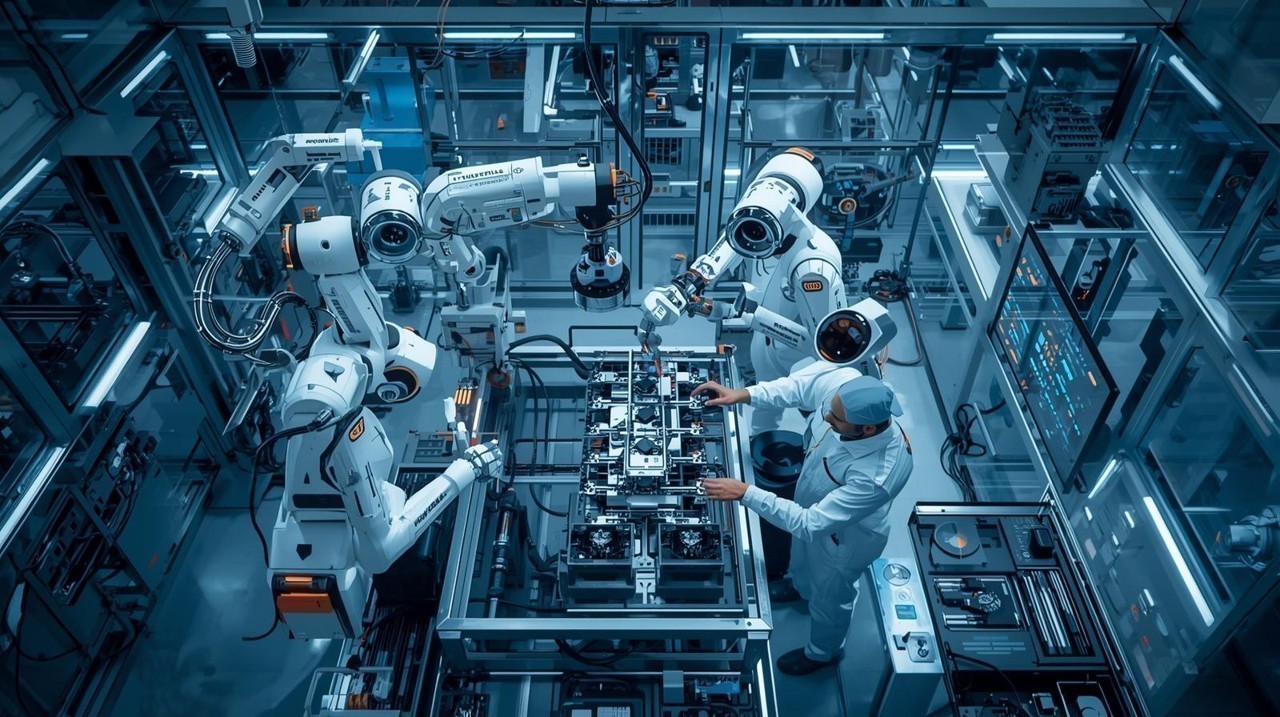
The world of manufacturing is experiencing a technological revolution, powered by the rise of Artificial Intelligence (AI) and robotics. Once driven by manual labor and traditional machinery, factories are now becoming smarter, faster, and more efficient than ever before.
From automated production lines to predictive maintenance and human-robot collaboration, AI and robotics are transforming how goods are designed, built, and delivered. This isn’t just an upgrade—it’s a complete redefinition of the manufacturing landscape.
Traditional manufacturing focused on efficiency through scale, but today’s manufacturing is about efficiency through intelligence.
Thanks to AI-powered analytics, machine learning, and robotic automation, factories can now make data-driven decisions in real time. The integration of these technologies is often referred to as Industry 4.0, representing the fourth industrial revolution — one that connects machines, people, and data seamlessly.
Gone are the days when robots were confined to repetitive assembly line tasks. Modern robots are smarter, more flexible, and safer to work alongside humans.
Unlike traditional industrial robots that require safety cages, collaborative robots, or cobots, are designed to work directly with human employees.
Cobots handle precision-based tasks like welding, packing, or quality inspection.
They can be easily programmed to switch between tasks.
They help reduce errors and increase overall production speed.
Companies such as ABB, KUKA, and Universal Robots are leading this trend, creating affordable cobots that even small and mid-sized manufacturers can integrate.
AI-driven AMRs are reshaping warehouse logistics. These mobile robots navigate factory floors, transport goods, and avoid obstacles using sensors and computer vision.
They not only reduce the need for manual labor but also improve workplace safety and efficiency — especially in large-scale facilities like Amazon’s fulfillment centers.
While robots serve as the “hands” of modern manufacturing, AI serves as the brain.
AI systems analyze massive amounts of production data to uncover inefficiencies, predict failures, and optimize performance.
One of the biggest advantages of AI is predictive maintenance — using data and sensors to detect potential machine failures before they occur.
This reduces costly downtime.
Helps schedule maintenance proactively.
Extends machine lifespan.
According to McKinsey, predictive maintenance powered by AI can reduce maintenance costs by up to 25% and cut unexpected breakdowns by 70%.
AI-powered computer vision systems are transforming quality assurance. Machines can now detect tiny defects invisible to the human eye — ensuring products meet exact specifications.
Manufacturers in industries like semiconductors, automotive, and pharmaceuticals rely heavily on these systems to maintain high quality standards and prevent recalls.
AI also enables end-to-end supply chain visibility. Through advanced algorithms, companies can:
Forecast demand more accurately.
Adjust inventory automatically.
Optimize shipping routes.
This intelligence helps reduce waste, improve delivery times, and lower costs — creating a more resilient global supply chain.
While automation is growing, humans remain essential. The future isn’t about replacing workers — it’s about empowering them.
AI and robotics handle the repetitive and dangerous tasks, freeing humans to focus on creative problem-solving and supervision.
Companies that train their workforce to work alongside intelligent machines are experiencing higher productivity and innovation rates. Upskilling programs and AI-based training simulations are helping workers adapt to this new hybrid model.
Every sensor, machine, and system in a modern factory generates data — often in terabytes per day.
AI turns this data into actionable insights, enabling real-time decision-making.
Smart factories use this data to:
Adjust production schedules automatically.
Detect performance bottlenecks.
Reduce energy consumption.
The more data collected, the smarter and more adaptive the system becomes — creating a continuous cycle of improvement.
Another major innovation reshaping manufacturing is the combination of 3D printing (additive manufacturing) and AI.
AI helps optimize designs for 3D printing, ensuring stronger, lighter, and more cost-effective components.
Industries like aerospace, automotive, and healthcare are using this combo to produce custom parts faster and cheaper than traditional methods — with minimal waste.
AI and robotics are also driving environmentally sustainable manufacturing.
Smart factories can:
Minimize energy waste through AI-driven monitoring.
Reduce material usage via precision robotics.
Cut emissions through optimized logistics.
For example, Siemens uses AI-powered energy management to reduce carbon emissions across its facilities, proving that efficiency and sustainability can go hand in hand.
Despite the progress, there are challenges:
High implementation costs for smaller manufacturers.
Cybersecurity risks due to connected networks.
Workforce displacement concerns due to automation.
Skill gaps in AI, data science, and robotics maintenance.
To overcome these, governments and businesses are investing in AI literacy programs and public-private partnerships that make technology adoption more inclusive.
Countries like Germany, Japan, South Korea, and China are leading the global smart manufacturing movement.
In India and the UAE, governments are encouraging Industry 4.0 initiatives to attract tech-driven investments.
Meanwhile, companies like Tesla, Foxconn, and Bosch are demonstrating how AI and robotics can scale production without compromising quality.
By 2030, the global smart manufacturing market is projected to exceed $800 billion, driven by AI integration and automation advancements.
The future of manufacturing points toward fully autonomous factories — facilities where AI systems manage production from start to finish with minimal human intervention.
Imagine:
Machines predicting demand and adjusting output automatically.
Robots assembling, inspecting, and packaging without pauses.
AI algorithms negotiating with suppliers in real time.
This vision is closer than ever, thanks to the rapid growth of AI, robotics, IoT, and 5G connectivity.
The combination of AI and robotics is redefining manufacturing as we know it. Factories are becoming smarter, safer, and more efficient, leading to better products and sustainable practices.
While challenges like cost and training remain, the benefits — from increased productivity to sustainability — are undeniable.
In the coming years, AI-powered smart factories will not just build products; they will shape the future of global industry.
The manufacturing revolution is here — and it’s intelligent, automated, and unstoppable.

US Stocks Slide as AI Fears, Inflation and Oil Surge Weigh
US stocks dropped as AI disruption fears hit tech firms, inflation rose above forecasts, and oil pri

Pacific Prime Wins Top Honors at Cigna Awards 2026
Pacific Prime secured Top Individual Broker and Top SME Broker awards at Cigna’s Annual Broker Award
QatarEnergy Halts LNG Output After Military Attack
QatarEnergy has stopped LNG production after military attacks hit its facilities in Ras Laffan and M

Strong 6.1 Magnitude Earthquake Hits West Sumatra, No Damage
A 6.1 earthquake struck off West Sumatra, Indonesia. No casualties, damage, or tsunami alert reporte

Saudi Confirms Drone Strike on US Embassy Riyadh
Two drones hit the US Embassy in Riyadh, causing a small fire and minor damage. No injuries were rep

UAE Restarts Limited Flights as Regional Airspace Disruptions Continue
UAE restarts limited flights from Dubai as US-Israel attacks on Iran disrupt regional airspace, forc

Asia Faces Energy Shock After Iran Closes Strait
Iran shuts Strait of Hormuz amid US-Israel strikes, sending oil prices higher and raising serious en


Bank of Baroda Faces Abu Dhabi Legal Battle over NMC Collapse
Bank of Baroda’s involvement in Abu Dhabi litigation tied to the NMC Healthcare collapse raises repu

Top Museum Openings of 2026 Set to Transform Global Tourism
From Los Angeles to Abu Dhabi and Brussels, 2026 brings major museum launches—Lucas Museum, Guggenhe

UAE Tour Highlights UAE’s Strength in Hosting Global Sports Events
Abu Dhabi Sports Council says the successful UAE Tour reflects the UAE’s leading role in hosting maj

EU Seeks Clarity from US After Supreme Court IEEPA Ruling
European Commission urges full transparency from the US on steps after Supreme Court ruling, emphasi
SpaceX Launches 53 New Satellites for Expanding Starlink Network
SpaceX launches 53 Starlink satellites in two Falcon 9 missions, breaking reuse records and expandin

RTA Awards Contract for Phase II of Hessa Street Upgrade in Dubai
Phase II of Hessa Street Development to add bridges, tunnel, and upgraded intersections, doubling ca

UAE Gold Prices Today, Monday 16 February 2026: Dubai & Abu Dhabi Updated Rates
Gold prices in UAE on 16 Feb 2026 updated: 24K around AED 599.75/gm, 22K AED 555.25/gm, and 18K AED

Over 25 Ahmedabad Schools Receive Bomb Threat Email, Authorities Investigate
More than 25 schools in Ahmedabad evacuated after bomb threat emails mentioning Khalistan. Authoriti