Post by : Mina Saadi
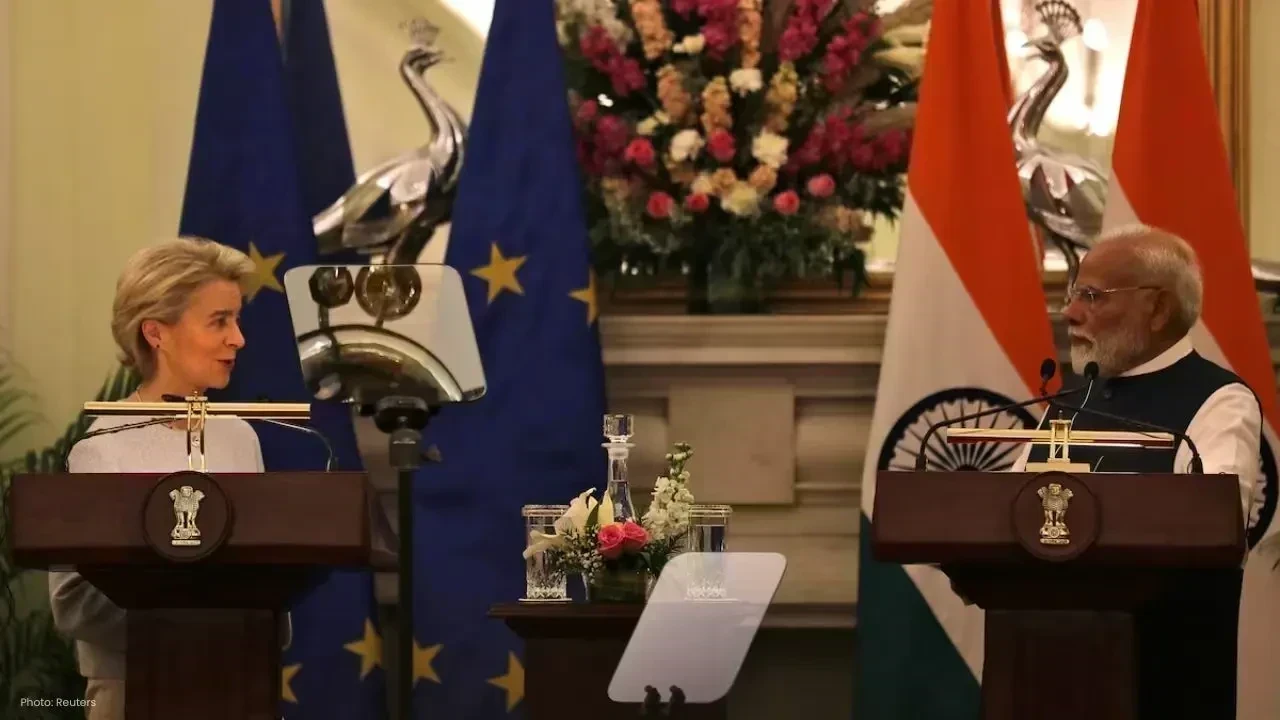
European Council President Antonio Luís Santos da Costa and European Commission President Ursula von der Leyen will be the distinguished guests at India’s Republic Day celebrations on Monday. This visit, while ceremonial, aims at reinforcing India-EU trade relations during a period of unpredictable global trade dynamics.
With state banquets and official engagements, both leaders are poised to discuss advancing the long-awaited India-EU Free Trade Agreement (FTA). This momentum comes as Europe seeks to broaden its partnerships beyond conventional allies, especially in light of ongoing trade tensions with the United States over tariffs and policies.
The presence of the EU’s highest officials at this national event signals more than mere symbolism. Analysts view it as reflective of India’s strategy to cultivate a balanced foreign policy alongside enhancing economic interactions with global partners.
The backdrop for this diplomatic endeavor is fraught with unresolved trade frictions between India and the United States, particularly regarding a 50% tariff dispute extending into the new year. In this context, the necessity for strengthened trade ties with the EU is gaining importance for New Delhi.
There are reports indicating a potential breakthrough on January 27, coinciding with a high-level summit where leaders from both factions are expected to convene. Senior leaders have referred to the proposed agreement as the “mother of all deals”, highlighting its significance.
Negotiations have been ongoing for nearly two decades, often hampered by disagreements over market entry, regulatory norms, and sensitive domestic sectors. However, recent discussions suggest a closer proximity to a resolution.
Should this agreement come to fruition, it would mark India’s ninth FTA in four years. India has made strides toward various trade deals with nations including the UK, Oman, and New Zealand as part of a broader strategy to diversify trade relationships.
For the EU, this pact would build upon recent trade collaborations with other global partners, including accords with Japan, South Korea, Vietnam, and the Mercosur bloc.
The European Union regards India as an emerging global economic force, currently the fourth-largest economy and one of the fastest-growing markets worldwide. India is set to surpass $4 trillion in GDP this year, potentially overtaking Japan.
EU officials believe that enhanced cooperation with India could unveil a vast marketplace of approximately two billion consumers, equating to nearly a quarter of global economic activity, thus positioning India as a valuable long-term ally for Europe.
As the largest trading bloc for India, a trade agreement could amplify Indian exports to European markets. India’s trade surplus is notable, exporting around $76 billion to the EU while importing about $61 billion.
A significant advantage of the deal would be reinstating more favorable market access after the EU lifted its Generalised System of Preferences (GSP) benefits in 2023, which diminished competitiveness for some Indian exports in Europe.
If finalized, this FTA could result in reduced tariff burdens for key Indian exports including textiles, pharmaceuticals, steel, and machinery, assisting local businesses in coping with amplified tariffs and market disruptions elsewhere.
During negotiations, India is likely to safeguard politically sensitive sectors like agriculture and dairy, while gradual tariff reductions may be implemented for industries such as automobiles and beverages, akin to previous agreements like the one with the UK.
This phased approach enables India to finalize significant trade agreements while temporarily setting aside more contentious issues, thereby addressing domestic concerns.
Despite notable advancements, the agreement still confronts significant challenges. The EU seeks stricter protections in areas such as intellectual property, data security, and patent rules.
A critical contention for India is the EU’s new carbon mechanism, the CBAM (Carbon Border Adjustment Mechanism), enacted this year. Experts caution that CBAM could impose additional costs on Indian exports, despite potential reductions in import tariffs.
This may pose especially burdensome for micro, small, and medium enterprises (MSMEs), given the increase in compliance demands and risks associated with emission benchmarks.
However, numerous analysts are optimistic that the India-EU agreement could facilitate a robust long-term alliance, assisting both entities in mitigating tariffs, supply-chain disruptions, and fluctuating trade strategies among major powers.
Concerns have been voiced in Europe regarding India's carbon output and human rights issues, which may spark debates in the EU parliament, required for the deal's ratification.
Analysts note that India's reduced procurement of Russian crude oil since November 2025 could enhance the agreement's acceptance within the EU.
This negotiation process is accelerating mainly because both sides acknowledge the necessity for stable commerce amid growing geopolitical tensions. As global trade dynamics shift, India and the EU seem poised to solidify a deeper economic affiliation.
If successfully concluded, this trade pact could become among the most significant agreements for India in recent years and provide Europe with a strategic partner in Asia.

US Stocks Slide as AI Fears, Inflation and Oil Surge Weigh
US stocks dropped as AI disruption fears hit tech firms, inflation rose above forecasts, and oil pri

Pacific Prime Wins Top Honors at Cigna Awards 2026
Pacific Prime secured Top Individual Broker and Top SME Broker awards at Cigna’s Annual Broker Award

QatarEnergy Halts LNG Output After Military Attack
QatarEnergy has stopped LNG production after military attacks hit its facilities in Ras Laffan and M

Strong 6.1 Magnitude Earthquake Hits West Sumatra, No Damage
A 6.1 earthquake struck off West Sumatra, Indonesia. No casualties, damage, or tsunami alert reporte

Saudi Confirms Drone Strike on US Embassy Riyadh
Two drones hit the US Embassy in Riyadh, causing a small fire and minor damage. No injuries were rep

UAE Restarts Limited Flights as Regional Airspace Disruptions Continue
UAE restarts limited flights from Dubai as US-Israel attacks on Iran disrupt regional airspace, forc

Asia Faces Energy Shock After Iran Closes Strait
Iran shuts Strait of Hormuz amid US-Israel strikes, sending oil prices higher and raising serious en


Bank of Baroda Faces Abu Dhabi Legal Battle over NMC Collapse
Bank of Baroda’s involvement in Abu Dhabi litigation tied to the NMC Healthcare collapse raises repu

Top Museum Openings of 2026 Set to Transform Global Tourism
From Los Angeles to Abu Dhabi and Brussels, 2026 brings major museum launches—Lucas Museum, Guggenhe

UAE Tour Highlights UAE’s Strength in Hosting Global Sports Events
Abu Dhabi Sports Council says the successful UAE Tour reflects the UAE’s leading role in hosting maj

EU Seeks Clarity from US After Supreme Court IEEPA Ruling
European Commission urges full transparency from the US on steps after Supreme Court ruling, emphasi

SpaceX Launches 53 New Satellites for Expanding Starlink Network
SpaceX launches 53 Starlink satellites in two Falcon 9 missions, breaking reuse records and expandin

RTA Awards Contract for Phase II of Hessa Street Upgrade in Dubai
Phase II of Hessa Street Development to add bridges, tunnel, and upgraded intersections, doubling ca

UAE Gold Prices Today, Monday 16 February 2026: Dubai & Abu Dhabi Updated Rates
Gold prices in UAE on 16 Feb 2026 updated: 24K around AED 599.75/gm, 22K AED 555.25/gm, and 18K AED

Over 25 Ahmedabad Schools Receive Bomb Threat Email, Authorities Investigate
More than 25 schools in Ahmedabad evacuated after bomb threat emails mentioning Khalistan. Authoriti





