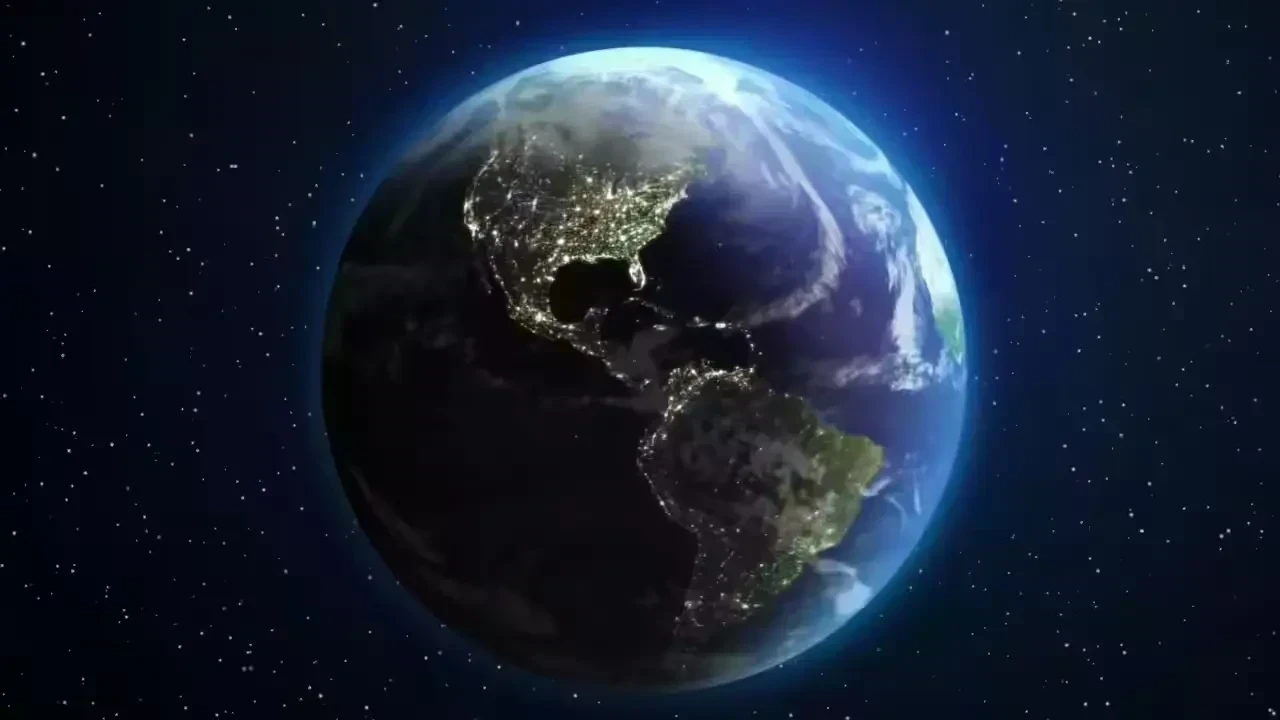
Post by : Anis Karim
The concept of Earth abruptly ceasing its rotation sounds like something out of a sci-fi movie. Many envision scenes of chaos: people launched into the void, oceans inundating land, and one hemisphere freezing while the other scorches. While these ideas have a grain of truth, the actual repercussions of a cessation of Earth's spin are far more intricate, unsettling, and rooted in science.
Earth spins at about 1,670 kilometres per hour at the equator, a fundamental aspect of life that often goes unnoticed. This motion governs gravity, climate, ocean currents, ecosystems, and even the biological processes of humans. Without it, the familiar world we know would vanish.
This article delves into the real outcomes if Earth were to stop rotating—whether suddenly or gradually—and reveals that the most alarming consequences are not what people typically imagine.
Earth's rotation goes beyond creating day and night; it also alters the nature of gravity itself. The centrifugal force generated by the rotation offsets gravity slightly, especially at the equator, causing the planet to appear as an oblate spheroid rather than a perfect sphere.
If the Earth halted, gravity would start pulling the planet towards a more spherical shape, leading to a reshaping of coastlines, submerging regions, and changing the balance between land and sea.
Additionally, the spin fuels the Coriolis effect, essential for wind and ocean currents. Its absence would disrupt global circulatory systems and lead to severe climate crises.
In an instant halt scenario, inertia becomes Earth's greatest foe. Everything on its surface—air, water, buildings, and life—would still move eastward at the planet's rotational speed.
At the equator, that speed surpasses that of many aircraft, resulting in global destruction:
Tsunamis would devastate coastlines
Supersonic winds would wreak havoc
Cities would face annihilation from kinetic force
Forests would be uprooted all across the planet
This wouldn't be a slow catastrophe—it would transpire within minutes.
However, since an instantaneous stop is virtually impossible, a more relevant inquiry is what transpires if Earth gradually decelerates.
A gradual deceleration avoids immediate devastation but does not shield life from long-term turmoil.
At present, Earth spins completely every 24 hours. With a slowing rotation:
Days would grow longer
Nights would become increasingly severe
Temperature variations would amplify
Eventually, we might see Earth become tidally locked, causing one hemisphere to eternally face the Sun while the opposite remains cloaked in darkness, similar to the Moon's position relative to the Earth.
Life would transition from marking “days” to experiencing contrasting hemispheres of light and shadow.
Weather phenomena arise from uneven heating combined with rotation. Absence of spin would rearrange atmospheric circulation entirely.
Instead of diverse wind patterns and jet streams, Earth would develop a colossal convection system:
Air would ascend on the sunlit side
Soar towards the dark side at high altitudes
Descend into perpetual cold
Return near the Earth's surface
This configuration would spawn relentless megastorms at the border where light meets dark, with winds surpassing any hurricane ever recorded.
Rain would continually drench certain regions while others would experience drought.
Currently, Earth's oceans are unevenly distributed due to rotational forces causing water bulging at the equator. Without this motion, that bulge would dissipate.
Water would migrate toward the poles, laying bare extensive equatorial land and flooding polar regions with vast seas.
The altered geography would feature:
Desertified equatorial landforms
Deep oceans encircling the poles
Wiped coastal ecosystems
Collapse of coral reefs and fish populations
Aquatic life would undergo mass extinction from rapid pressure shifts, temperature extremes, and oxygen depletion.
Earth's magnetic field, produced by molten iron movement in the outer core—a process reliant on planetary rotation—would falter as spin wanes.
Over time:
The magnetic field could collapse
Solar rays would access the atmosphere directly
Atmospheric particles could be stripped away
Exposure to radiation would escalate significantly
While this wouldn't happen abruptly, over vast geological timelines, Earth might start resembling Mars—cold, lifeless, and exposed.
In a gradual slowing scenario, life wouldn't vanish instantly, but adaptive measures would be crucial.
Intense heat
Continuous solar exposure
Severe dehydration risks
Diminished biodiversity
Life might retreat underground or evolve to withstand harsh conditions.
Permanent cold
Oceans locked in ice
Minimal photosynthetic activity
Only extremophiles—organisms adapted to harsh environments—would survive.
The narrow strip between light and shadow would become the most favorable habitat for life, reminiscent of ecosystems thriving around oceanic hydrothermal vents.
Modern civilization is contingent upon:
Predictable weather patterns
Stable agricultural practices
Reliable transport networks
Consistent energy sources
All of these factors hinge on Earth’s rotation.
Agriculture would collapse under chaotic seasonal shifts. Infrastructure would weaken facing climatic upheavals. Migration crises would escalate beyond control.
Even advanced technology would struggle to sustain billions under these dire circumstances.
Earth is not on course to stop spinning arbitrarily. Its angular momentum keeps it in motion. To halt would require a tremendous external force, likely causing total destruction.
Only monumental events such as:
A tremendous planetary collision
A close brush with a rogue celestial body
Interference from a cosmic-scale force
could genuinely affect Earth's spin. All these events would spell extinction long before halting spin could become an issue.
One common misunderstanding is that halting Earth’s rotation would erase gravity. This is incorrect.
Gravity derives from mass, not from motion. Earth would still exert nearly the same gravitational pull minus the rotation.
What would alter is the sensation of gravity, particularly at the equator, where centrifugal force lessens gravity's effect. While humans might feel slightly heavier, that’s among the lesser concerns facing the planet.
This thought experiment doesn’t aim to predict future events, but rather to reveal how finely balanced Earth's systems are.
Rotational motion is crucial for:
Climate equilibrium
Oceanic movement
Atmospheric safeguarding
The very conditions for life
Earth is not merely a space rock; it is a meticulously tuned system where rotational motion sustains life.
The most astonishing realization isn’t how chaotic Earth would become post-spin, but rather how vital that spin is for existence.
A marginally faster rate would lead to intensified storms, while a slower spin would render climate unpredictability. Earth thrives within a slim margin for complexity.
That delicate balance is often overlooked—until one imagines its abrupt absence.
Should Earth stop spinning, it wouldn't result in people flying into space or immediate darkness. Instead, it would unravel the intricate systems that quietly sustain life.
The significant threat lies not in spectacle but in systemic breakdown.
Earth rotates not only to create day and night, but to nourish oceans, shield the atmosphere, regulate weather, and support all life forms. Though Earth would remain, it would no longer resemble the world we know.
Disclaimer:
This content is for educational and informational purposes only. The scenario discussed is speculative and not indicative of any likely planetary event.

Thousands March in Caracas, Demand Maduro’s Release
Thousands of Maduro supporters marched in Caracas, one month after a deadly US raid ousted him, dema

Sheikh Mohammed Visits WGS 2026 Media, Cybersecurity Centres
Sheikh Mohammed visited the WGS 2026 media and cybersecurity centres in Dubai, highlighting media’s
Sitharaman Meets World Bank President Ajay Banga on Viksit Bharat Plan
Finance Minister Nirmala Sitharaman met World Bank President Ajay Banga to discuss the new Country P
PM Shehbaz Meets WBG President Ajay Banga to Boost Pakistan Reforms
PM Shehbaz Sharif meets World Bank President Ajay Banga, discussing economic reforms, development pr
Italy’s Unemployment Hits Record Low of 5.6% in December
Italy’s unemployment fell to a historic 5.6% in December, the lowest since 2004, with employment at

Australian Open Champ Rybakina Headlines Dubai Tennis Elite Field
Fresh from her Australian Open triumph, Elena Rybakina returns to Dubai as a resident and WTA 1000 c
Deloitte Champions Enterprise & Public Sector Innovation at Web Summit Qatar
Deloitte leads masterclasses on in-country cloud, AI, and tech governance at Web Summit Qatar 2026,


Why Drinking Soaked Chia Seeds Water With Lemon and Honey Before Breakfast Matters
Drinking soaked chia seeds water with lemon and honey before breakfast may support digestion hydrati

Morning Walk vs Evening Walk: Which Helps You Lose More Weight?
Morning or evening walk Learn how both help with weight loss and which walking time suits your body

What Really Happens When You Drink Lemon Turmeric Water Daily
Discover what happens to your body when you drink lemon turmeric water daily including digestion imm

DXB News Network Presents “Ctrl+Alt+Wim”, A Bold New Satirical Series Starring Global Entertainer Wim Hoste
DXB News Network premieres Ctrl+Alt+Wim, a bold new satirical micro‑series starring global entertain

High Heart Rate? 10 Common Causes and 10 Natural Ways to Lower It
Learn why heart rate rises and how to lower it naturally with simple habits healthy food calm routin

10 Simple Natural Remedies That Bring Out Your Skin’s Natural Glow
Discover simple natural remedies for glowing skin Easy daily habits clean care and healthy living ti

Mattel Revamps Masters of the Universe Action Figures for Upcoming Film
Mattel is set to revive Masters of the Universe action figures in sync with their new movie, ignitin

China Executes 11 Members of Infamous Ming Family Behind Myanmar Scam Operations
China has executed 11 Ming family members, linked to extensive scams and gambling in Myanmar, causin