Post by : Anis Karim
In mid-January 2026, the world experienced a remarkable celestial event as Earth was struck by a severe solar radiation storm, rated as S4 on the NOAA scale—the strongest since 2003. A surge of high-energy particles from the Sun influenced Earth’s magnetic environment and triggered significant reactions throughout space and the upper atmosphere.
Solar storms occur when the Sun emits streams of charged particles, primarily protons, at incredible speeds. These energetic particles penetrate Earth’s magnetic shield, increasing radiation levels in near-space. The S4 storm was fueled by a powerful X-class flare and a massive coronal mass ejection (CME), releasing a substantial cloud of plasma and magnetic material from the Sun.
This storm not only showcased impressive strength but also garnered worldwide attention due to its visibility and potential repercussions. Space weather scientists, including researchers from NOAA and ESA, are meticulously monitoring the storm's development as it interacts with Earth.
The January 2026 event stemmed from a notable X1.9 flare emitted by an active region on the Sun. X-class flares are known for their capacity to release vast energy and project charged particles into space. Following the flare, a fast-moving CME ejected a significant mass of solar material toward Earth.
Such CMEs can provoke disruptions to Earth’s magnetic field if they are directed towards our planet. In this instance, the rapid arrival of the CME set off intense geomagnetic activity, raising solar radiation levels within near-Earth space. This potent interaction has culminated in a major radiation storm.
The combination of the X-class flare and CME is a key contributor to serious space weather phenomena. When particles from a CME interact with Earth’s magnetic shield, they cause disturbances that result in geomagnetic storms, capable of creating visually striking effects while challenging technological infrastructures.
Solar radiation storms are classified from S1 (minor) to S5 (extreme) according to their intensity. An S4 (Severe) rating indicates heightened radiation levels that can impact satellites, spacecraft, and aviation operations. This current storm, rated S4, is notable for being the most intense since the events of 2003.
The storm's strength is not merely a theoretical concern; it represents a significant uptick in energetic particles entering near-Earth space, directly affecting human activities and machines beyond Earth’s atmospheric protection—especially pertaining to low-Earth orbit and high-latitude air routes.
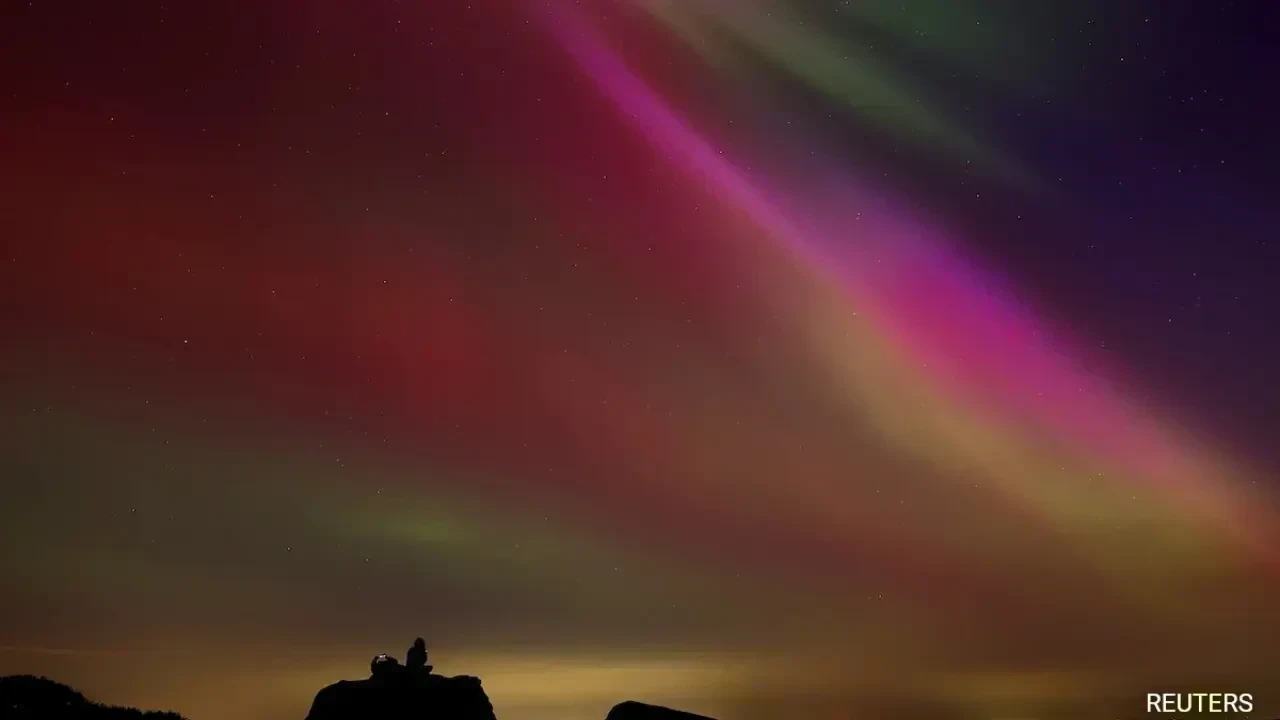
One of the most dazzling results of the solar radiation storm has been the expansive display of auroras—both Northern and Southern Lights—appearing at latitudes far from their typical locations. Generally restricted to polar areas, auroras illuminated skies ranging from the United States across to Europe and even extended into mid-latitude territories.
People across North America witnessed striking auroras in shades of green, red, and pink, reaching down to places like California, Texas, and Alabama, where such phenomena are rare. Reports of equally awe-inspiring views came from Europe, as well as regions like Ireland, which experienced a vibrant display deemed historic.
In the Southern Hemisphere, the aurora australis also showcased unusual sightings, visible in parts of Australia and New Zealand not typically associated with strong auroral displays.
Such widespread auroras result from solar particles following Earth’s magnetic lines towards the poles, colliding with atmospheric gases and producing light. Intense geomagnetic disturbances can expand the auroral oval, permitting breathtaking views for observers worldwide.
While the visual spectacle has been captivating, the storm's heightened radiation poses risks to modern technologies. Satellites orbiting Earth are particularly at risk from increased particle levels, which can disturb electronic systems, degrade solar panels, and disrupt navigation and communication capabilities.
Space agencies and satellite operators are closely observing these effects, implementing precautionary measures such as adjusting satellite operations or placing them into safe modes to minimize disruptions. For instance, GPS systems can face temporary accuracy issues during intense space weather occurrences.
This storm also holds consequences for aviation, especially for flights crossing polar regions. Increased solar radiation poses heightened exposure risks for passengers and crew, which could interfere with high-frequency radio communications essential in remote polar areas.
Aviation authorities have been advised to reassess routes and communication protocols to ensure safety during this event. Although the risks generally do not present dire threats to flight safety, they can influence operational efficiency and necessitate vigilant management amid severe space weather.
Solar storms of this magnitude are exceptional but not unheard of. The Halloween storms of 2003 are often cited in relation to this event due to their extensive geomagnetic disruptions and astonishing auroras seen at lower latitudes.
Historical accounts also reference even more intense instances, such as the Carrington Event of 1859, which produced auroras worldwide and disrupted telegraph systems. While the January 2026 storm does not compare in intensity to the Carrington Event, it highlights the potential impacts of significant solar activity cycles.
According to solar activity studies, this event coincides with the ongoing Solar Cycle 25, a period characterized by heightened sunspot and flare activity, signifying naturally occurring peaks in solar eruption intensity.
Scientists are employing a network of satellites and ground instruments to closely monitor this solar storm’s evolution and its effects. Tools like NOAA’s GOES satellites are measuring solar wind properties, particle fluxes, and magnetic interactions, providing real-time data for forecasters.
Collaboration between global agencies, including the European Space Agency (ESA), ensures the collection of comprehensive data that enriches both scientific knowledge and practical readiness. This monitoring is essential for identifying hazards, forecasting auroral activity, and advising infrastructure operators on imminent effects.
As the storm progresses, scientists will be alert for several key developments:
Whether solar wind conditions remain elevated, sustaining geomagnetic activity.
Duration of the enhanced auroral visibility at lower latitudes.
Any subsequent solar flares or CME events that might extend or amplify space weather outcomes.
Geomagnetic storms may last several days before Earth’s magnetic field stabilizes and solar wind conditions normalize. However, prolonged effects are possible, particularly if further solar activity occurs. Continuous monitoring remains vital to evaluate ongoing impacts and potential risks.
Disclaimer: This article reflects scientific observations and reports available at the time of writing. Space weather is inherently dynamic, and conditions can change swiftly. For the most accurate updates, refer to official space weather forecasting centers and scientific organizations.

Predictheon Wins WHX Xcelerate Innovation Champion 2026
Predictheon won WHX 2026 Xcelerate, earning US$12,000, WHX 2027 space and global exposure for its AI

Omantel Launches Otech to Drive Oman’s Future Tech Vision
Omantel launches Otech to accelerate Oman’s digital transformation, strengthen data sovereignty, exp

Daimler Truck MEA Honors Top Distributors at EliteClass 2025
Daimler Truck MEA hosted EliteClass Awards 2025 in Dubai, honoring top distributors across 19 catego

King Mohammed VI Launches Safran Landing Gear Plant in Morocco
Morocco strengthens its aerospace leadership as King Mohammed VI launches Safran’s €280M landing gea

Qatar Emir Sheikh Tamim Arrives in UAE on Fraternal Visit
Qatar’s Emir Sheikh Tamim bin Hamad Al Thani arrived in Abu Dhabi on Saturday. UAE President Sheikh

Shaidorov Wins Stunning Olympic Gold as Malinin Falters
Kazakhstan’s Mikhail Shaidorov won men’s figure skating gold after US star Ilia Malinin fell twice.

Shakira’s 5-Show El Salvador Residency Boosts Bukele Image
Shakira’s five sold-out concerts in San Salvador highlight El Salvador’s security shift under Bukele


Why Drinking Soaked Chia Seeds Water With Lemon and Honey Before Breakfast Matters
Drinking soaked chia seeds water with lemon and honey before breakfast may support digestion hydrati

Morning Walk vs Evening Walk: Which Helps You Lose More Weight?
Morning or evening walk Learn how both help with weight loss and which walking time suits your body

What Really Happens When You Drink Lemon Turmeric Water Daily
Discover what happens to your body when you drink lemon turmeric water daily including digestion imm

DXB News Network Presents “Ctrl+Alt+Wim”, A Bold New Satirical Series Starring Global Entertainer Wim Hoste
DXB News Network premieres Ctrl+Alt+Wim, a bold new satirical micro‑series starring global entertain

High Heart Rate? 10 Common Causes and 10 Natural Ways to Lower It
Learn why heart rate rises and how to lower it naturally with simple habits healthy food calm routin

10 Simple Natural Remedies That Bring Out Your Skin’s Natural Glow
Discover simple natural remedies for glowing skin Easy daily habits clean care and healthy living ti

Mattel Revamps Masters of the Universe Action Figures for Upcoming Film
Mattel is set to revive Masters of the Universe action figures in sync with their new movie, ignitin

China Executes 11 Members of Infamous Ming Family Behind Myanmar Scam Operations
China has executed 11 Ming family members, linked to extensive scams and gambling in Myanmar, causin