Post by : Rajat Arora
First Computer Running on Living Human Brain Cells Shown to the World
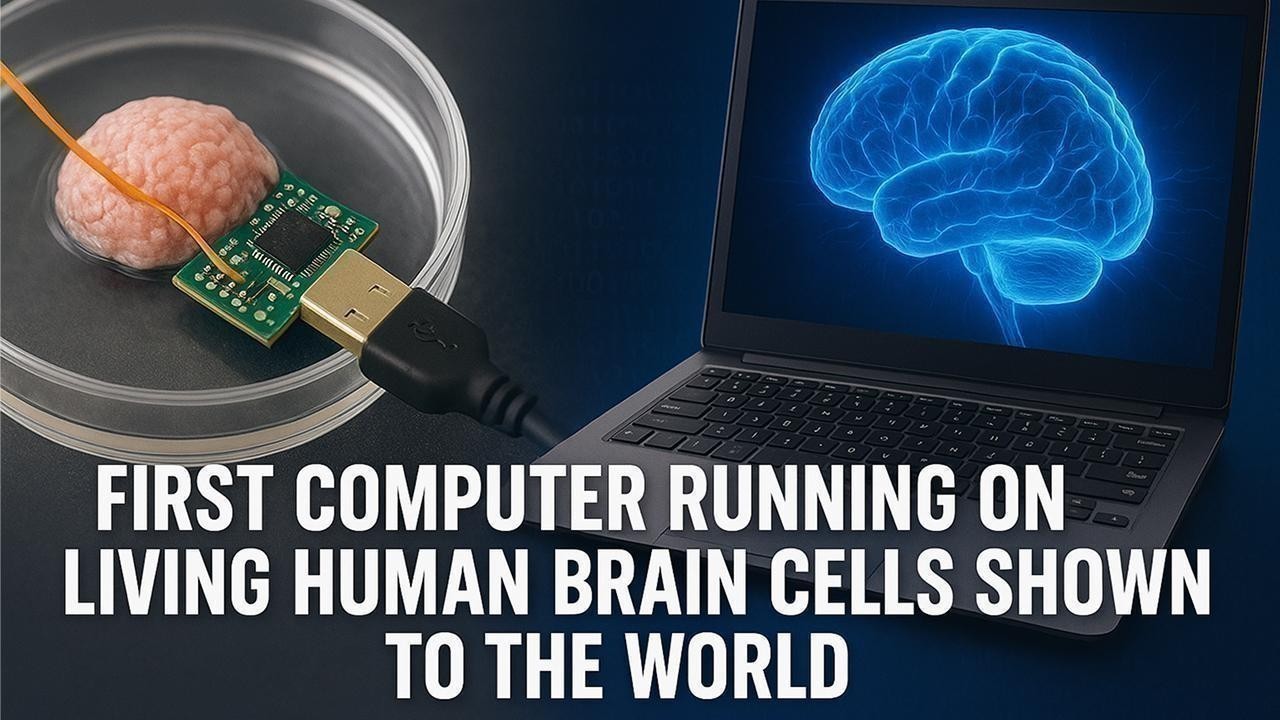
In a moment that feels straight out of science fiction, scientists have officially unveiled the first computer running on living human brain cells. This revolutionary breakthrough blends biology and technology in a way we’ve never seen before, setting the stage for a future where machines are not just silicon and code — but also living tissue.
But how exactly does this work? Why are researchers turning to brain cells instead of traditional circuits? And what does this mean for the future of computing, artificial intelligence, and even human health?
Let’s break it all down.
What Is This Bio-Computer, and How Does It Work?
The first computer running on human brain cells, often called a biocomputer, uses a collection of lab-grown neurons — human brain cells cultivated in a dish — connected to electronic systems.
These neurons communicate with each other just like they do inside our brains, generating electrical signals, forming connections (synapses), and adapting over time. Researchers use specialized interfaces to link these biological networks to computers, allowing the system to process information, learn patterns, and even solve tasks.
This isn’t just a fancy experiment — it’s a whole new type of machine. Instead of relying solely on microchips, the first computer running on living brain cells blends the adaptability of biological systems with the precision of digital circuits.
Why Use Living Brain Cells in a Computer?
Traditional computers, even the most powerful supercomputers, have limitations. They process tasks sequentially, burn huge amounts of energy, and struggle to mimic the adaptability and parallel processing power of the human brain.
Here’s where bio-computing shines:
Energy efficiency — The human brain operates on just 20 watts of power, compared to megawatts consumed by large data centers.
Learning capability — Neurons naturally rewire and strengthen their connections based on experience, offering unmatched learning and adaptability.
Parallel processing — While digital systems process one operation at a time, brain networks handle countless operations simultaneously.
By integrating living cells, the first computer running on human neurons promises not only raw computational power but also a system that can learn, adapt, and potentially solve problems in entirely new ways.
What Did Scientists Reveal?
During the official demonstration, scientists showed that this biocomputer could:
Recognize patterns — The system was able to “learn” how to respond to specific inputs over time, just like a simple brain would.Adapt to changes — Unlike traditional computers that need reprogramming, the neuron-based system adjusted its behavior when the environment shifted.Store information — Researchers observed that the living brain cells could hold and retrieve information, pointing to possible future memory systems.
One of the lead researchers said,“This is not about replacing silicon-based computers, but about exploring hybrid systems where biology and technology can complement each other.”
In short, the first computer running on living brain cells is a proof of concept — but its potential is enormous.
What Could This Mean for the Future?
This breakthrough opens up fascinating possibilities across multiple fields:
Artificial Intelligence — Imagine AI systems that aren’t just coded but are partially grown, learning and adapting in ways we currently can’t program.
Medical research — These systems could help us understand brain diseases like Alzheimer’s, by providing live, testable models.
Energy-efficient computing — Data centers are energy-hungry giants; integrating biocomputing could dramatically cut power consumption.
Ethical and philosophical questions — As machines become part-living, we’ll need to rethink what “consciousness” and “machine intelligence” really mean.
While it’s still early days, the first computer running on living neurons marks the start of a new chapter in technology.
Are There Risks or Challenges?
Of course, such groundbreaking technology comes with challenges.
Scalability — Right now, these systems are tiny. Scaling up to match modern computers will take years, if not decades.Ethical concerns — Using human brain cells in machines raises serious ethical questions: Are we creating life? Could these systems develop awareness?Stability — Living cells are delicate, requiring precise environments to survive and function over time.
Scientists are moving cautiously, ensuring that progress is matched with ethical oversight.
Disclaimer
The information provided in this article is for general informational purposes only. While DXB News Network strives to ensure accuracy and reliability, we make no guarantees regarding the completeness, timeliness, or accuracy of the content. Opinions expressed are those of the authors and do not necessarily reflect the views of DXB News Network.
Photo: Chatgpt

NDP MP Leah Gazan Stands Firm on MMIWG2SLGBTQQIA+ Usage
Leah Gazan defends the term MMIWG2SLGBTQQIA+ amid backlash, insisting it distracts from violence and

Grand National Horse Dies After Winning Despite Injury
A racehorse suffered a fatal injury during a Grand National event, finishing first before being euth

Man from Badger Faces Murder Charges in Grand Falls-Windsor
A 52-year-old man has been charged with first-degree murder following a woman's death in Grand Falls

Tragic Train Incident Claims Life of Pedestrian in Richmond Hill
A pedestrian lost their life after being struck by a GO train in Richmond Hill. Police are investiga

Chlorine Gas Incident Hospitalizes Eight in Victoria
A chlorine gas leak at Crystal Pool in Victoria resulted in eight hospitalizations and significant e

Major Investment Boosts Quebec's Graphite Sector
Canada Growth Fund allocates $113 million to enhance Quebec's Matawinie project's role in critical m

Canada to Unveil New Initiatives for Youth Employment
Canada is set to introduce initiatives aimed at boosting job opportunities for young Canadians acros


Wired vs Wireless Charging: Which Is Better for Speed and Battery Health?
Wired vs wireless charging explained. Learn which is faster, safer for battery life, and better for

Sent Email by Mistake? Easy Ways to Unsend or Fix It Fast
Sent an email by mistake? Learn how to unsend, recall, or fix emails quickly with simple tips to pre

Foods You Should Avoid in Summer to Stay Safe in the Heat
Avoid harmful foods in summer heat. Learn what not to eat to stay cool, hydrated, and healthy with s

How to Keep Children Hydrated in the Summer Heat
Easy tips to keep children hydrated in summer heat Help kids stay cool active and safe with simple d

7 High-Protein Breakfast Ideas for Busy Mornings
Start your day right with 7 quick high-protein breakfasts Easy healthy ideas to keep you full active

The UAE Wellness Secret: 7 Life-Changing Tips
Discover 7 simple UAE wellness tips to stay healthy active and stress-free Easy daily habits for bet

UAE Art Show in Seoul Challenges Stereotypes
Exhibition in Seoul highlights diverse UAE art, moving beyond luxury stereotypes to explore identity

Starbucks Strikes Major Partnership for China Growth
Starbucks teams with Boyu Capital, selling a majority stake in China unit to ramp up store growth an